 Image courtesy of Broad + Liberty
Antisemitism persists at Haverford, Philly schools despite federal scrutiny
Beth Ann Rosica’s writings are a blend of news, opinion, and analysis.
A recent rally at Swarthmore College in Delaware County demonstrates the depth of anti-American and anti-Israel sentiments across the region. Protestors were caught on camera, chanting, “Iran, Iran, you make us proud! Take another soldier out! Hezbollah, you make us proud.”
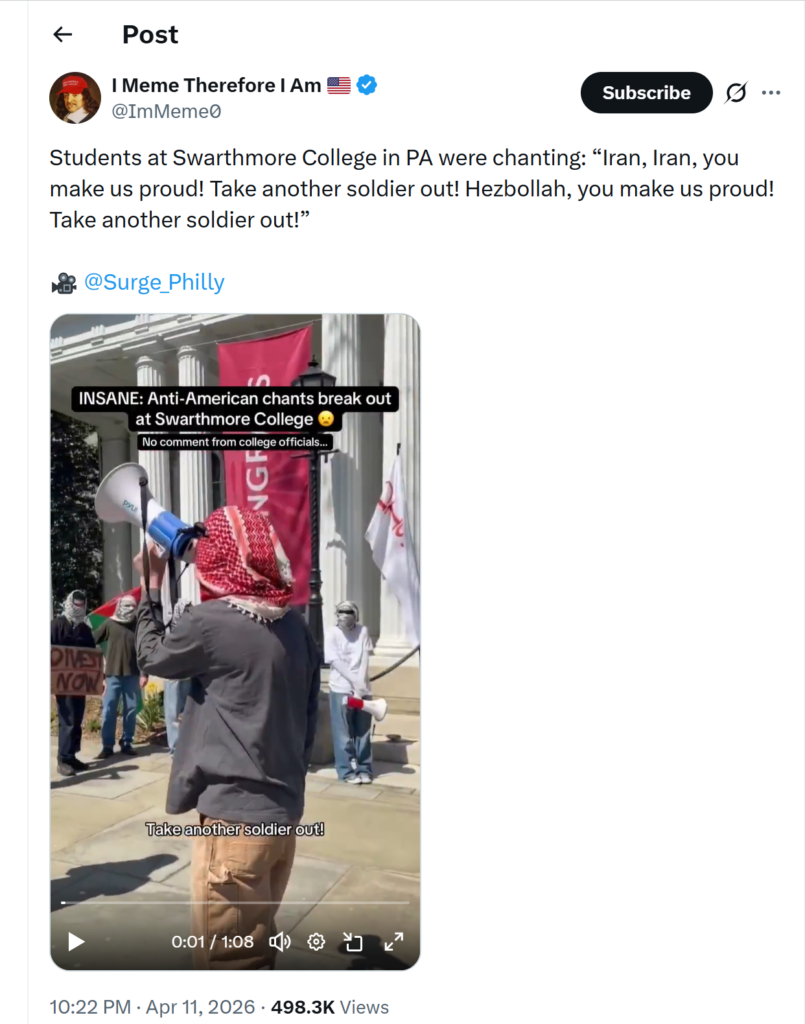
While the video does not specifically reference Jews or Israel, the protestors praise groups that are tied to violence against Jews and celebrate the killing of American and Israeli soldiers.
According to recent reports, this behavior, and more specifically, antisemitism, has become increasingly visible across Southeastern Pennsylvania, prompting federal intervention which has drawn mixed reactions — some see improvement, while others argue it falls short. Haverford College and the School District of Philadelphia (SDP) are under scrutiny in investigations led by the U.S. House Education and Workforce Committee.
Despite federal involvement, some students and faculty still believe antisemitism is a major problem at Haverford and SDP that requires both government and community attention if it is to be properly addressed.
“Jews on campus, that is the Zionists at least, are still worried for their safety,” Barak Mendelsohn, Jewish professor of Political Science at Haverford College.
Haverford College
The House committee published a report last month detailing a dozen universities’ failure to address antisemitism. Haverford College is prominent in the findings. Under Republican Chairman Tim Walberg’s (Michigan, 5th District) leadership, How Campuses Became Hotbeds: The Rise of Radical Antisemitism on College Campuses cites three primary reasons: a lack of strong leadership by university presidents, faculty members legitimatizing and amplifying antisemitism, and some student groups acting as ringleaders for the harassment targeted towards Jewish students.
Less than a year ago, Broad + Liberty reported on the pervasive antisemitism facing both Jewish students and faculty at Haverford College.
Chairman Walberg said in a request for comment that Haverford is not doing enough to protect Jewish students.
“Antisemitism is spreading like a virus at schools across our nation,” Walberg told Broad + Liberty. “My Committee’s recent report exposes how — at schools like Haverford — weak leaders repeatedly appeased and surrendered to antisemitic students and faculty. In front of my own Committee, President Wendy Raymond utterly failed to denounce antisemitism, putting school administrators’ weakness on full display. Schools like Haverford must do more to protect Jewish students and address discrimination. Enough is enough.”
In February, Haverford hosted Haviv Rettig Gur, a prominent Israeli journalist and senior political analyst for The Times of Israel, and his lecture was disrupted by radical anti-Israel protestors. Following the incident, Gur wrote in The Free Press, “I met young people starved for wisdom and authority who had been told that their every emotional kink and outburst was valid and unassailable truth. (One university staff member confided to me that if they’d told the kids, as I did, that they were being childish and ignorant, they’d have been summarily fired.)”
The House report references incidents and social media posts at Haverford involving a Jewish pro-Israel professor, Barak Mendelsohn, and a pro-Palestinian professor, Tarik Aougab.
Broad + Liberty interviewed Mendelsohn last May, and since that time, he reports, “the problem of antisemitism at Haverford improved to some extent in the past year, especially since the President’s disastrous performance in Congress.”
However, he confirmed the findings of the report.
“I’ve often said that our problem is a trinity of antisemitism composed of administration-faculty-students, much as the congressional report determined,” said Mendelsohn. “At Haverford the college leadership is still giving support for acts of antisemitism, some faculty are still indoctrinating students while also maintaining close contact with the Student Council and with the Haverford SJP [Students for Justice in Palestine], and the Student Council is tainted by antisemitism.”
Mendelsohn noted the report did not contain much new information about Haverford, but the emails cited “show a clear distinction between how Haverford treated the main conveyors of antisemitism on campus versus its treatment of Zionist [those who support Israel’s right to exist] Jews. Leadership, of which none is Jewish, decided to adopt a definition of antisemitism that would allow antisemitism to continue by rejecting the notion that anti-Zionism is antisemitism. Had a definition of anti-black racism been adopted by white people, there would have been an outrage, but when it comes to Jews, people think they have the right to define for us what constitutes hate.”
The report alleges Haverford leadership treated pro-Palestinian professors more favorably than Zionist Jewish professors.
“Haverford has repeatedly offered comfort and support to faculty members who spread antisemitism online after the October 7th attacks. Most prominently, in October 2023, Haverford mathematics professor Tarik Aougab posted online describing students who were counter-protesting at an anti-Israel protest as ‘racist genocidaires.’ Days after the terrorist attack, Aougab shared a post describing the attack as ‘imprisoned people breaking free from their chains.’ The post also stated, ‘[t]his was a historic moment to be recorded in the history books.’”
According to the report, Haverford president Wendy Raymond met with Aougab following the posts in order to foster “dialogue and mutual understanding.” The administration praised him for his bravery and honesty.
The report concurs with Mendelsohn that he received the opposite treatment.
“Conversely, when an Israeli professor at Haverford criticized the school’s handling of antisemitism online and students responded by attacking him, Haverford administrators condemned the professor internally and launched an investigation.”
President Raymond did not respond to a request for comment. Professor Aougab responded that he did not have time to respond and noted that his general political stances could be gleaned from his online writings.
“Unfortunately I don’t have space in my schedule during the semester either for an interview, or to think carefully about how to summarize all of my feelings and thoughts about this in one comment. So, I’ll have to decline.”
School District of Philadelphia
The School District of Philadelphia has been accused of persistent and pervasive antisemitism directed toward Jewish students and teachers from multiple organizations, including the Jewish Federation of Greater Philadelphia, Jewish American Friends and Families Alliance, the Deborah Project, the PSD Jewish Families Association, the Committee for Accuracy in Middle East Reporting and Analysis, and the Gevura Fund.
Some groups filed complaints with the U.S. Department of Education’s Office of Civil Rights (OCR), which led to an investigation and subsequent findings in December 2024 that the district did not adequately address antisemitic behaviors nor did it protect accusers from retaliation.
“The evidence the District has produced to date confirms that it received repeated, extensive notice of harassment based on shared ancestry that could create a hostile environment, as well as notice that the Complainant and some teachers and students alleged experiencing retaliation.”
The investigation resulted in a voluntary settlement agreement, requiring a number of actions, including training, data collection, updated policies and procedures, climate assessments, and reporting to OCR.
Despite the implementation of the agreement, accusations of antisemitism continue. Last November, the U.S. House Education and Workforce Committee launched an investigation into the School District of Philadelphia (SDP).
“Considering the repeated allegations of antisemitic discrimination across SDP, the Committee is requesting documents to assess SDP’s compliance with Title VI and determine whether legislation to specifically address antisemitism discrimination is needed.”
Earlier this year, the Committee for Accuracy in Middle East Reporting and Analysis (CAMERA) released a report detailing how antisemitism is embedded in multiple facets of the district.
“SDP has institutionalized an ideological framework that legitimizes radical narratives aimed at undermining and delegitimizing not only Israel — and fostering hostility toward Jewish students and teachers — but also the United States itself,” the report concluded. “In doing so, SDP has reframed the study of history as an exercise in grievance, cultivating a generation of students trained to view the past through the lens of activism rather than scholarship.”
SDP disputes the findings and last month Communications Director Monique Braxton reinforced the district’s commitment to the agreement.
“The District has been actively implementing the terms of the voluntary resolution agreement with the U.S. Department of Education and is cooperating with the House Committee’s inquiry.”
Despite the voluntary settlement agreement with OCR and the Education and Workforce Committee investigation, pervasive discrimination against Jewish students remains, according to a recently filed lawsuit.
The Gevura Fund, a nonprofit dedicated to combating antisemitism in the workplace and education institutions, recently filed a lawsuit against the U.S. Department of Education, alleging the voluntary settlement agreement (VRA) failed to rectify the hostile environment and OCR failed to enforce the very minimal stipulations.
“The VRA’s terms were, at best, a bandage on a bleeding wound, and at worst, a hasty attempt to simply close out an investigation,” the lawsuit alleges.
Gevura Fund Founder and President Tina Snider filed the complaint in federal court against the U.S. Department of Education on behalf of one of its members who resides in the district.
“This case represents a critical moment for accountability,” said Snider. “When the institutions responsible for protecting civil rights fail to act, it is essential that organizations like Gevura step forward. We are proud to support this effort to ensure that the promises of Title VI are not just words on paper, but protections that are meaningfully enforced.”
The mounting reports, investigations, and now litigation reflect a growing consensus among advocacy groups that existing remedies have fallen short. Whether through congressional inquiries, federal enforcement, or the courts, pressure on educational institutions is only increasing. What remains to be seen is whether that pressure will finally produce the accountability and protections Jewish students have long been promised.
Beth Ann Rosica resides in West Chester, has a Ph.D. in Education, and has dedicated her career to advocating on behalf of at-risk children and families. She covers education issues for Broad + Liberty. Contact her at [email protected].